Featured Projects

Mie resonators

Mie resonators for infrared meta-optics

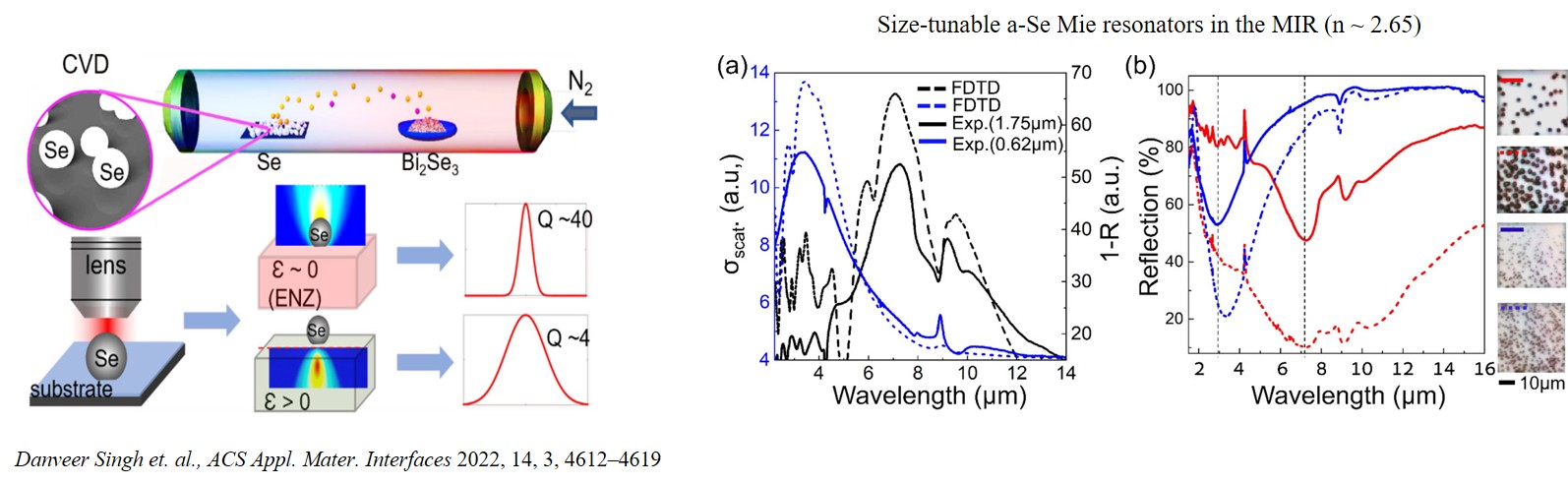
Scalable, large-area Se spheres on several substrates demonstrate Mie-resonant response in the mid-infrared (2–16 μm) spectral range. Capable of strong absorption up to 90% in particle ensembles, with ultra-high-Q resonances when coupled to low-loss epsilon-near-zero substrates. These findings open avenues for on-chip MIR spectroscopy, chemical sensing, and large-area metasurface fabrication.

Read paper → ACS Appl. Mater. Interfaces 2022, 14, 3, 4612–4619
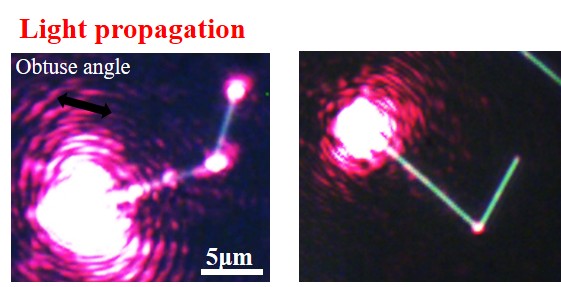
Nanowire-Nanoparticle system: switchable optical nano-antenna

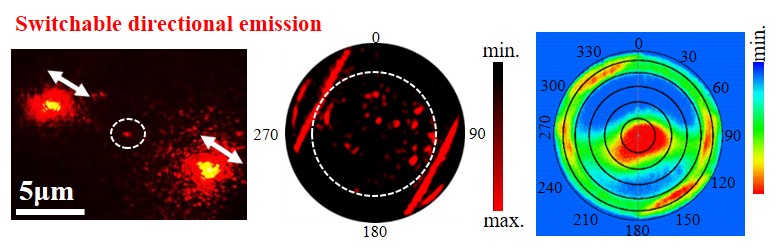
A hybrid system of coupled single nanoparticle and single nanowire enables single- and dual-directional out-coupling of light from the NW-NP junction. The junction can influence directional fluorescence emission, functioning as an optical antenna with implications for directional single-photon sources and quantum plasmonic circuitry.

Read more → Optics Letters, 40, 1006–1009 (2015)
Nanowire nanoparticle system
Plasmonic beam splitter

Serially coupled plasmonic silver nanowires

Propagation and localization of light at sub-wavelength scale is a key challenge in nanophotonics. Metallic nanostructures supporting surface plasmons enable subwavelength light control. We explore silver nanowires (Ag-NW) as circuit elements that can perform logical functions analogous to electronic components — building blocks of nanophotonic circuits.

Read paper → Appl. Phys. Lett. 101, 111111 (2012)

Curved-space plasmonics

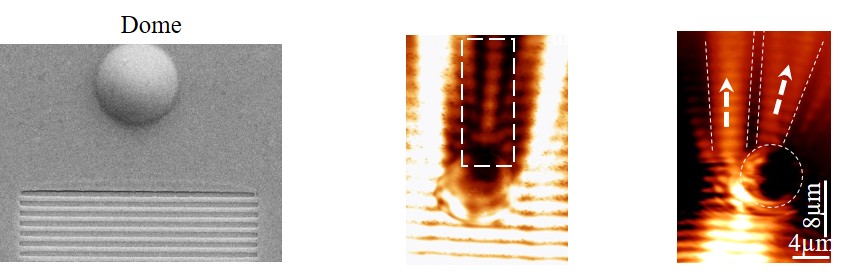
The propagation dynamics of surface plasmonic waves can be controlled by surface curvature. Curvature acts as an effective potential, altering propagation of surface plasmon polaritons. This opens a new degree of freedom for manipulating surface waves by curving the metal–dielectric boundary — enabling novel beam steering and focusing.

Read paper → Optics Letters 44, 5234–5237 (2019)
Curved space plasmonics
Dual channel Fourier microscopy

Dual-channel Fourier microscopy & spectroscopy

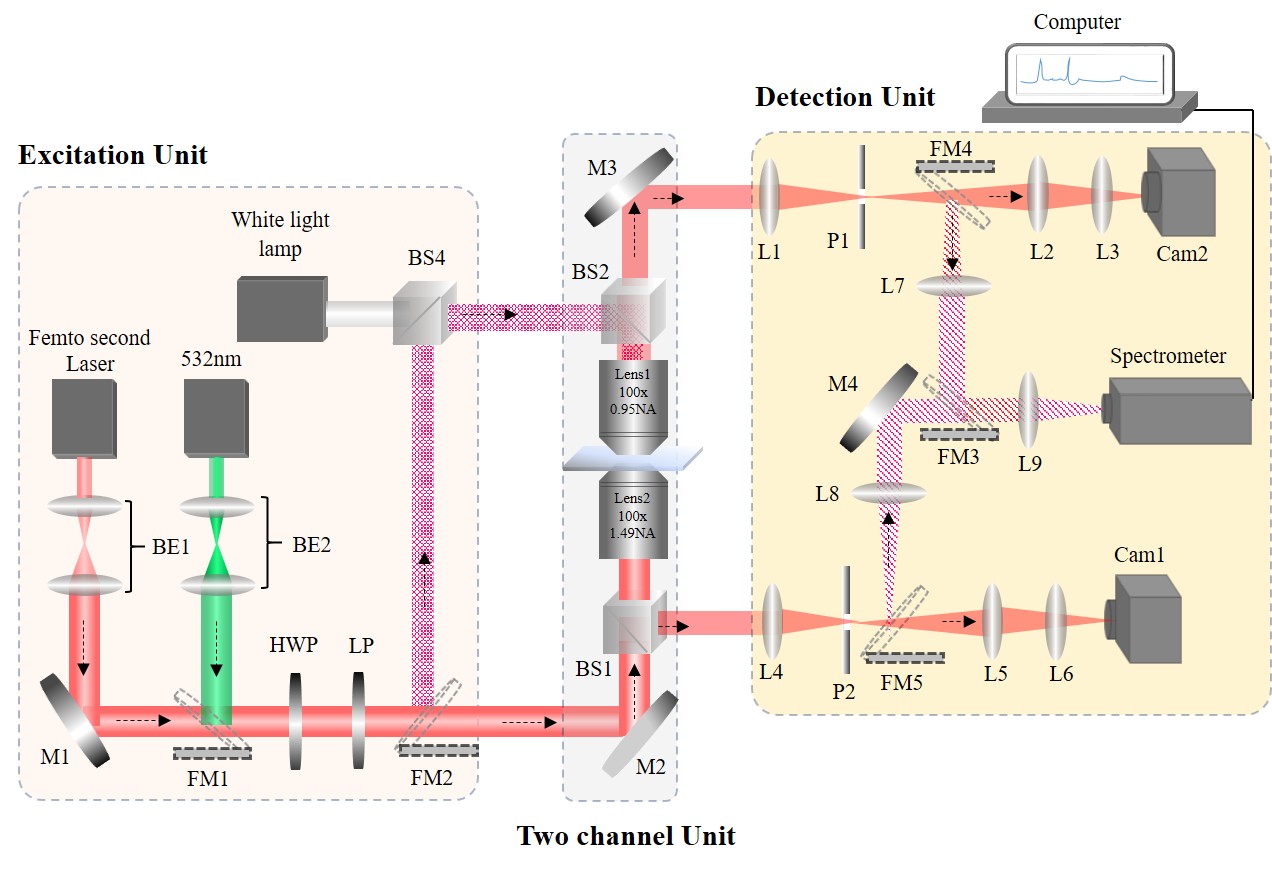
A dual-channel Fourier-plane microscopy system to study directional emission characteristics from individual nanostructures — organic mesowires, Ag nanowires, and 2D MoS₂ nanolayers. Quantifies angular spread in waveguided photoluminescence through glass substrate or air superstrate, enabling investigation of optical antenna structures at interfaces.

Read paper → Optics Communications 398, 112–121 (2017)